Why Integrated Parking Beats the Operator-Plus-Vendors Model
Most parking programs are split across an operator and a stack of technology vendors, and the owner pays for every handoff. Here's why one integrated partner for operations, technology, hardware, and payments delivers more parking NOI.

Who answers when the gate fails? Why one accountable company beats the operator-plus-vendors model
Consider a common scenario: at 6 p.m. on a weekday, an entry gate fails and traffic begins to queue onto the street. In most garages, resolving it involves several parties. The operator contacts the equipment vendor, the vendor opens a service ticket, and the property manager fields tenant complaints in the meantime. Often, the gate stays open until the repair is made, and the property loses revenue for as long as it stays that way.
Most owners would name one company as responsible for their parking: the operator. The invoices usually tell a different story, with five or six vendors involved.
Alongside the operator that staffs the garage, there is typically a gate and equipment vendor, a payment processor, validation software, a reporting tool, and often a separate insurance line. Each adds a fee and manages one part of the operation. None is accountable for the overall result.
That is the core issue with how parking is managed today. The problem is not any individual vendor. It is a model that spreads accountability across so many companies that no one owns the outcome: not the gate failure at 6 p.m., not the invoice, and not the parking NOI.
Parking has become a black box
In the traditional model, the owner hires an operator, and the operator stitches together third-party technology. The owner gets back a monthly PDF, usually weeks after the fact.
When revenue misses budget, it's hard to say why. Was it unbilled validations, expired passes, a lane that was down for three days, or a rate that hasn't changed in years? Each vendor can see its own piece. No one sees the whole P&L.
The problem isn't your parking team. It's the incentives built into the model:
- More labor means more cost. Labor is typically billed cost-plus, so a busier garage office means a bigger bill, not a better operation. This is the primary revenue driver for operators, so they have no incentive to optimize the system.
- More vendors means more fees. Every system needs someone to run it, reconcile it, and chase its support tickets, and you’re billed back for that time.
- More equipment means more CapEx. Hardware vendors get paid when you replace gates, not when you avoid replacing them.
- More handoffs means slower fixes. When a gate fails at 6 p.m., the operator calls the equipment vendor, who opens a ticket, while drivers wait and your property manager takes the calls.
None of these companies is working against you on purpose. They're doing what their business model rewards. The result is higher costs, leakier revenue, and a worse experience for tenants and drivers.
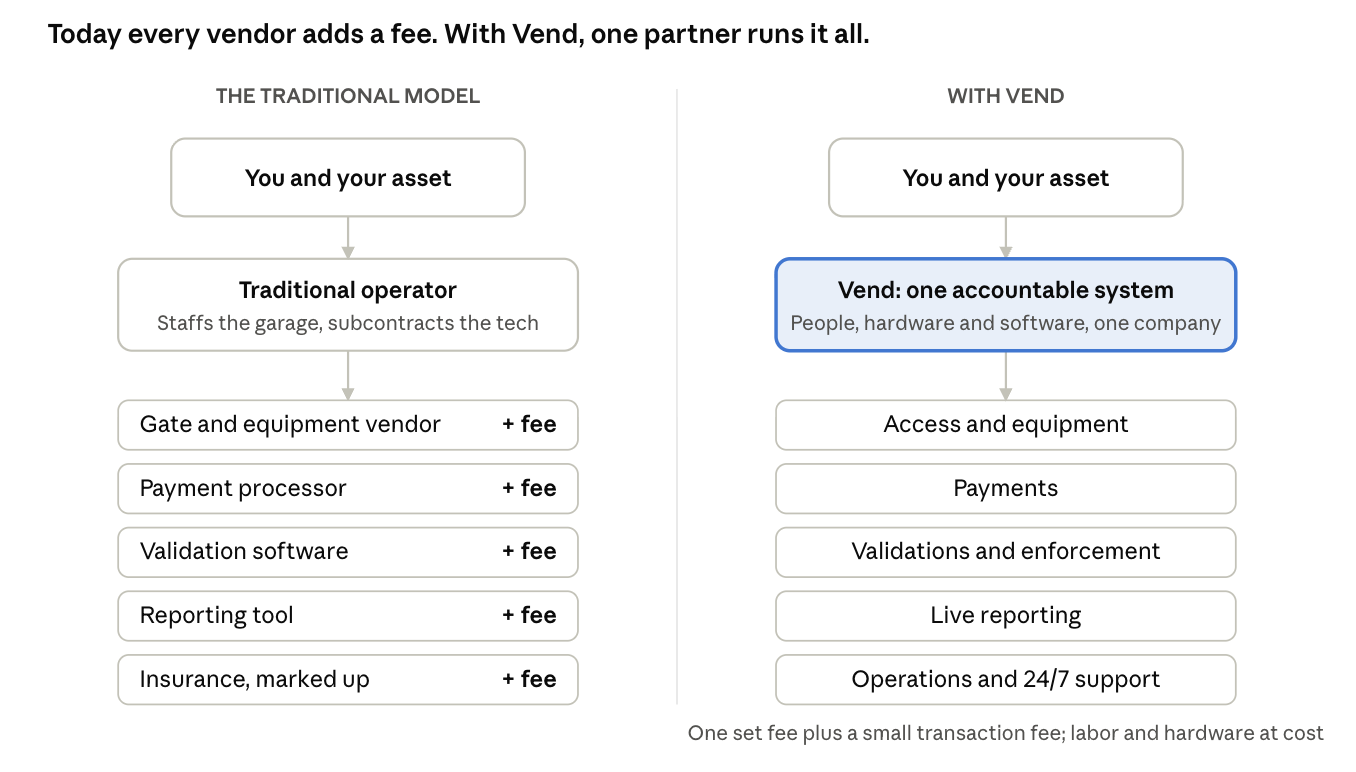
What changes when one company runs everything
Vend is the parking operating system for commercial real estate. We combine the technology, equipment, and people required to run parking into one accountable system. Access, payments, validations, enforcement, reporting, and day-to-day operations all run on it, and we own every piece.
We run the operation, the technology, and the money. You hold one company accountable.
That structure changes the economics in four ways.
1. Your operating costs come down
Because we built the software and own the hardware, automation and 24/7 remote support can replace most on-site labor without leaving drivers stuck. When a gate fails, a real person sees the lane and fixes it in about 7 seconds. Not a ticket. Not a callback. The staff who remain go where the data says they add value, and labor passes through at cost, never marked up.
Owners see 35% average operating cost savings across the Vend portfolio. That's a portfolio-wide number, not one best-case site.
2. You capture revenue you already earned
Every unbilled validation is NOI you already earned. When access, payments, validations, and enforcement live on separate systems, sessions fall through the gaps between them. On one system, every session, pass, and validation is billed.
Across the Vend portfolio, 99.9% of transactions are captured, and one property saw about 80% fewer violations within a month of launch.
3. You avoid CapEx you don't need
An equipment vendor makes money when you replace equipment. We make money when the garage runs well. So we often retrofit what you have, or include the equipment with a no-CapEx option.
The average owner avoids $190K in equipment costs. At two mixed-use districts in the DC metro, the owner avoided a $2M equipment bill and added $400K+ in NOI.
4. You find new revenue
With one system and one team, you don't need new vendors to launch new revenue streams. Lease audits, empty-space sales, street and curb parking, and grant-funded EV programs launch on the same platform, often within weeks.
At one Class A office, a lease audit found $200K in the first week. At a mixed-use retail center, street parking revenue grew 55% year over year after Vend took it over.
One partner means one answer
The financial case is only half of it. The other half is what happens on an ordinary Tuesday.
- When something breaks, there's one number to call, and the person who answers can see the lane, fix the session, and open the gate. No calling a technology vendor and waiting.
- When the asset manager asks why parking missed budget, there's a live P&L that shows every session, rate, invoice, and lease term. The variance comes with an explanation, not a shrug.
- When a tenant needs a validation rule changed, it's changed in the portal, not routed through three companies by email.
- When the invoice arrives, every line is shown: a set fee plus a small transaction fee, stated up front, with labor and hardware passed through at cost.
That's what accountability looks like in practice. One system. One team. One answer.
The results
Owners who switched to an integrated model have seen:
- Class A office: a 29% NOI increase and 30% lower operating costs, while avoiding $300K+ in equipment replacement.
- Nuveen, a newly acquired Class A office: revenue 84% above budget in year one.
- Two mixed-use districts, DC metro: $400K+ in NOI lift, and $2M in CapEx avoided, with fewer than 2% of visitors needing any help.
- A mixed-use retail center: ~$300K+ in annual NOI after replacing its operator, with street parking revenue up 55% year over year.
See what your parking could be earning
If your parking is split across an operator and a stack of vendors, there's a good chance it's earning less than it should. Let's chat to see what your parking could be earning.